Braiding and Knots
Table of Contents
Braids
Wikipedia article on the Braid Group A braid can be formed by exchanging the endpoints of strings. Take for example a braid with i = 5 points.
We can represent an exchange with (i-1) number of operations, σ1, σ2, σ3,
σ4 . σi exchanges the i point with the i+1 point. The inverse of an exchange
σi-1 is just exchanging it the opposite way.
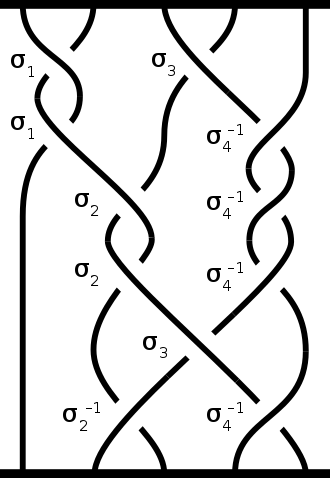
Braiding has the same properties as a group!
- The Indentity is the braid with straight lines (no crossings)
- Any combination of braidings is also a braiding
- For any braiding, the inverse can be found by flipping the picture

One might want to compare the Braid Group to the Permutation Group Sn, since the Braid Group also involves switching points around. Indeed there is a surjective homomorphism Bn→Sn however, the Braid Group is infinite while Sn is not. The Braid group will have some extra conditions, In the case of B4
- σ1
From Braids to Knots
A link is a collection of knot and they can be formed from taking the closure of a braid. This is done by connecting opposite ends of the strings by lines that do not intersect like such:
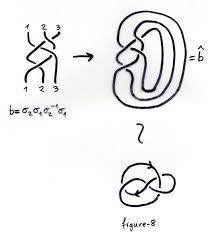
Alexander's Theorem states that every knot or link is the closure of some Braid. However, there can be many closed Braids that coorespond to the same knot/link. Markov's Theorem gives the conditions that tell whether or not two Braids lead to the same knot/link.